
Saint Paul’s Church, Shankill
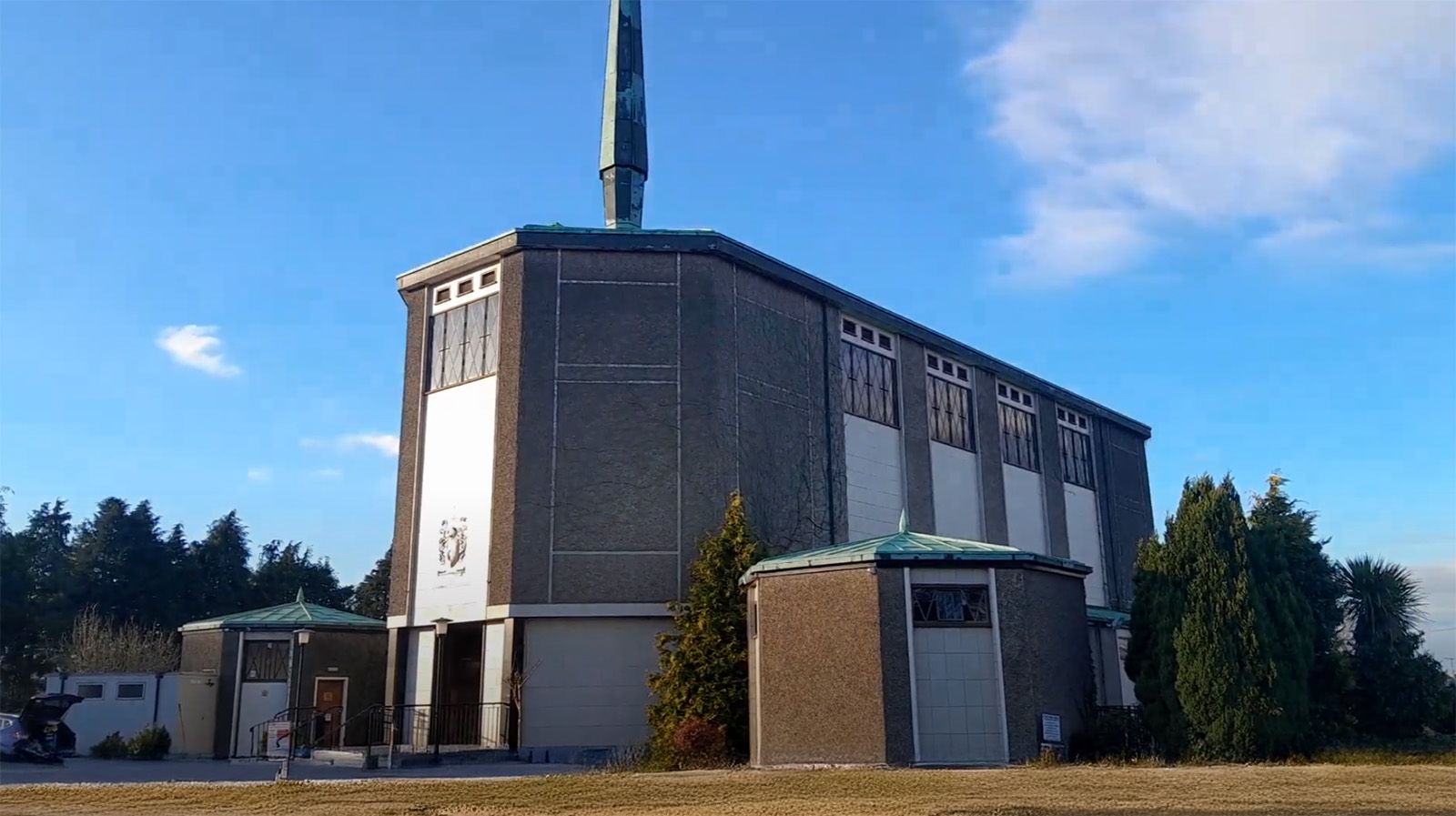
Standing proudly at the historic juncture where Francis Street, Edward Street, and the Portadown Road meet – an area traditionally known as “the head of the plain”- Saint Paul’s Church has served its local community for over sixty years. The site’s transformation from being a sporting ground to becoming the location for what was once hailed the “most modern church in Ireland” is a captivating story of parish growth, architectural boldness and local pride.
Long before the foundation of Saint Paul’s, the ground on which it sits was known to locals as Celtic Park. In the early decades of the twentieth century, the ground had become the home of Lurgan Celtic Football Club. By the 1930s and 1940s the energy had shifted, as greyhound racing came to dominate the grounds.
The work of expanding local parish facilities – which eventually led to Saint Paul’s Church – began in earnest during the 1950s, under the guidance of Very Reverend Monsignor Edward Campbell, who was appointed Parish Priest of Shankill on March 20, 1955.
A major turning point for the eventual church site came in April 1959, with the passing of Miss Emile Piché (Emma) Donnelly. In a remarkable act of generosity, she bequeathed the Celtic Park site to the Shankill Catholic Parish – paving the way for a much-needed new place of worship to serve Lurgan’s gradually expanding population.
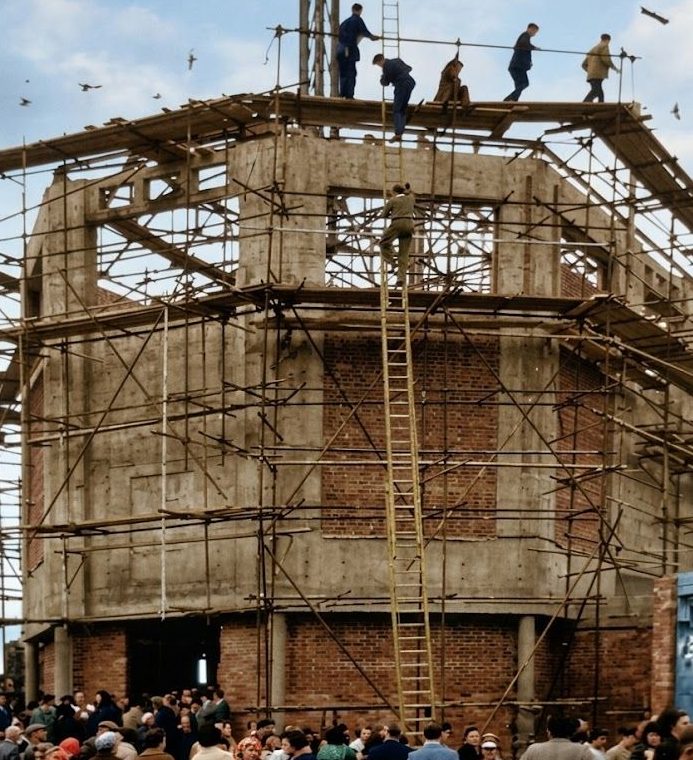
Construction & Completion, 1963–1965
- The Dublin-based architectural practice of Messieurs Thomas J. Ryan was entrusted with the design for Saint Paul’s and their proposed, bold structure challenged traditional church aesthetics.
- After groundwork began on the site, parishioners and clergy gathered for the first formal milestone of the church. Bishop Eugene O’Doherty blessed and laid the foundation stone on September 12, 1963 – a historic marker that remains visible to the left of the main entrance doors today.
- The original building contractors, Carville & Sons of Warrenpoint, encountered serious difficulties which brought site progress to a temporary standstill in late 1963.
- The immense financial pressure and structural complications took a heavy toll on Monsignor Campbell’s health. He died, before the project was completed, on January 9, 1964.
- Very Reverend James Haughey succeeded Monsignor Campbell on April 1, 1964. He immediately prioritised completing the new church.
- In April 1964, new contractors, Gilbert Ash Limited, were appointed – successfully resuming construction in May 1964.
- By the close of 1965, the ambitious plan had been realised and the new church was complete. The local press enthusiastically declared Saint Paul’s to be the “most modern church in Ireland” – boasting a seating capacity of 850 and designed to comfortably accommodate the surrounding neighbourhoods of Shankill and Taghnevan.
- Mass was celebrated in Saint Paul’s for the very first time, on the Fourth Sunday of Advent, December 19, 1965. The opening of their new church would make the approaching Christmas an unforgettable one for the local worshipping community.
- Just eight days after its opening, Saint Paul’s hosted its first wedding, on December 27, 1965. This was the celebration of the marriage of Brian Thornbury and Miss Mona McAvoy.
Solemn Dedication & Consecration, 1966
On Sunday, April 17, 1966 (Low Sunday), crowds gathered in Francis Street for the official, solemn dedication and consecration of Saint Paul’s.
- Visiting prelates were received at Saint Peter’s Church before travelling across town in a decorated car cavalcade to Saint Paul’s. The Guest of honour was the Belfast-born Cardinal William Conway (Archbishop of Armagh), who attended alongside Monsignor James Haughey and Dean Bernard Mooney (Parish Priest of the neighbouring Seagoe Parish). The liturgical procession into the new church was led by Cross Bearer, Patrick Byrne, while local members of the Order of Malta provided a Guard of Honour.
- Following the dedication ceremony, a Solemn Mass was celebrated before a capacity congregation by Canon James Burke – assisted by Deacons, Reverend Gerard McCrory and Reverend Rory McKee. All three were proud Lurgan natives. The sermon was delivered by the Most Reverend Anthony McFeely (Bishop of Raphoe). Bishop Eugene O’Doherty (Dromore) and Bishop William Philbin (Down and Connor) were also in attendance.
- Following the Solemn Mass, celebrations continued at the nearby Saint Paul’s Secondary School, where a festive reception was held.
Architectural & Design Features of Saint Paul’s
The new Saint Paul’s Church stood out as a leading example of a new style of Catholic architecture within Ireland in that era:
- Exterior and Layout: The church was built with non-traditional grey plasterwork and featured a copper roof and a small, slim tower. Two additional hexagonal rooms flanked the entrance – originally designated as a baptistry, on one side, and a mortuary on the other.
- Post-Vatican II Adaptations: Following mid-1960s liturgical reforms (Second Vatican Council reforms), the mortuary fell out of regular use, as practices around funerals gradually changed. Meanwhile, the celebration of baptisms moved from the entrance area of the church into the main sanctuary.
- Restrained Interior: The interior of Saint Paul’s was much less decorative than older Catholic church buildings. Perhaps the most striking and colourful interior feature of the church is its Stations of the Cross, set within stained-glass window panels. Neither did the church have traditional ‘side altars’ – with the emphasis being upon the main altar at the centre of the sanctuary. This altar was a gift of the Lurgan Sisters of Mercy.
- Local Craftsmanship and Gifts: The mahogany pews for the new church were carved locally, while the large wooden crucifix – fixed above the sanctuary – was presented to Saint Paul’s by the Parish Priest, Monsignor Haughey. Meanwhile, a black-and-white plaster tablet above the main entrance displays words from Saint Paul’s First Letter to the Corinthians: IMITATORES MEI ESTOTE (“Be ye imitators of me”). These words are seen as offering all who worship at Saint Paul’s a motto and an inspiration, drawn from the writings of its patron. This plaster tablet was a gift of Thomas Ryan, the church’s architect.
Six Decades of Faithful Service
While minor adaptions to the sanctuary of Saint Paul’s were undertaken in the course of subsequent decades, the church has remained largely as it was when originally dedicated in 1966. It has served the people of the southern side of Lurgan town very faithfully throughout those decades and has been the cherished setting for many familial and parochial occasions down through the years.
One particular highlight for Saint Paul’s and its congregation was the visit of the then Irish Primate, Cardinal Tomas O’Fiaich, on Easter Monday, April 16, 1990 – when the prelate celebrated a Mass within the church in the Irish language.
A series of celebrations were held in the course of 2016 to mark the Golden Jubilee of Saint Paul’s Church. Primary among these was a Golden Jubilee Mass which Bishop John McAreavey celebrated on Sunday April 17, marking – to the day – the solemn dedication of the church fifty years earlier. A commemorative calendar was produced by the parish for that fiftieth anniversary year. It relayed, through its various photographs, something of the story of Saint Paul’s.
Formal Division of Shankill Parish
The historic parish of Shankill was reconfigured in the autumn of 1992, when Bishop Francis Gerard Brooks discerned that the community surrounding and served by Saint Paul’s Church should become an independent parochial unit. This led to the creation of the new parish of Saint Paul’s Shankill. In consequence, a corresponding parish of Saint Peter’s Shankill also came into being. The decree delineating the two emerging entities was issued by the Bishop on September 4, 1992. Their territories were detailed as follows:
- Parish of Saint Peter’s Shankill: Covers the townlands of Kinnego, Clanrolla, Liscorran, Tullydagan, Tannaghmore North, Lurgantarry, Cornakinnegar, Drumnanoe, Tullyronnelly, Kilmore, and Killaghy, along with parts of Lurgan, Drumnakelly, Ballyblagh, Dougher, Knocknashane, Derry, and Turmoyra.
- Parish of Saint Paul’s Shankill: Covers the townlands of Annaloiste, Boconnell, Knockramer, Silverwood, Shankill, Taghnevan, Tannaghmore South, Toberhewney, Aughnacloy, and Tirsogue; along with parts of Lurgan, Drumnakelly, Ballyblagh, Dougher, Knocknashane, Derry, and Turmoyra; part of Ballinamoney (the remainder being in Seagoe); and part of Monbrief (the remainder being in Moyraverty).
Throughout the following two decades, each Lurgan parish had its own specific clerical personnel. However, reducing numbers of diocesan priests eventually made this pastoral arrangement unsustainable. Since late 2012, therefore, Saint Peter’s and Saint Paul’s parishes have, once again, been served by the same team of clergy.
Doctor Francis McCorry Kieran Clendinning
Father Andrew McMahon Jim Conway