
Early Origins and Boundaries
The Parishes of Shankill and Seagoe cover an expansive region along the southern shore of Lough Neagh. Until the modern Parish of Moyraverty was created, Shankill and Seagoe were the only two parishes within the Diocese of Dromore located in County Armagh. Under Catholic administration before approximately 1750, Seagoe was considered the primary and more prominent of the two.
- 1440: Due to Seagoe’s small parish income, it was formally united with the neighbouring Lough Shore parish of Enachloisgy (Annaloiste). Dean Bernard Mooney maintained that the Church of Annaloiste was Kilwilke (derived from Kylmilcon, linked to an early local saint named Micho or Milchu).
- 1492: Further consolidation took place, uniting Tayagoba (Seagoe), Acadle (Aghalee), and Kylmilan (Shankill). Although some historical theories conflate Kylmilan, Kilwilke, and Shankill, few modern historians accept this identification. Shankill and Seagoe remained bound together under a single administrative union for nearly three centuries.
- 1609: Early records for Shankill remain obscure, but Plantation maps from 1609 record the presence of a pre-Reformation church site in Shankill townland, near what would become the centre of Lurgan. The founding of Lurgan by incoming Brownlow settlers elevated Shankill’s local prominence. The original Shankill church was taken over by Anglican settlers following the Plantation, though local Catholics continued using the adjacent cemetery.
- 1704: On July 10, 1704, during the mandated registration of Catholic priests at the Lurgan courthouse, no priest appeared specifically for Shankill. Reverend John Byrne, the parish priest of Seagoe, registered on behalf of both parishes. Despite this official record suggesting Shankill lacked its own minister, local Church of Ireland baptismal registers record that Reverend Richard McGinn was administering Catholic baptisms in the district during this period.
- 1760: Pinpointing eighteenth-century Mass sites in Shankill remains difficult. However, a “Mass-garden” in Tannaghmore North appears on cartographer John Rocque’s 1760 map of County Armagh.
- 1788: The long-standing administrative union between Shankill and Seagoe parishes was officially dissolved.
- 1800: The landlord Brownlow family gifted a mill-warehouse near the Dougher stream, as a Mass site, to local Catholics. It was converted into a chapel to serve a population that was then almost entirely rural and living outside the main town.
- 1819: The Most Reverend Edmund Derry (Bishop of Dromore and a native of Ballynamoney) transferred nine and a half townlands from Seagoe to Shankill: Drumgask, Moyraverty, Annaloiste, Boconnell, Drumnakelly, Kinnego, Knockramer, Silverwood, Turmoyra, and half of Ballynamoney.
- 1822: Systematic registration of Catholic baptisms had begun in the parish. Reverend William O’Brien had arrived as a curate in Lurgan – officially becoming Parish Priest of Shankill in 1824.
- 1827: Charles Brownlow donated the field surrounding the Dougher chapel for use as a Catholic graveyard.
The Story of Saint Peter’s Church
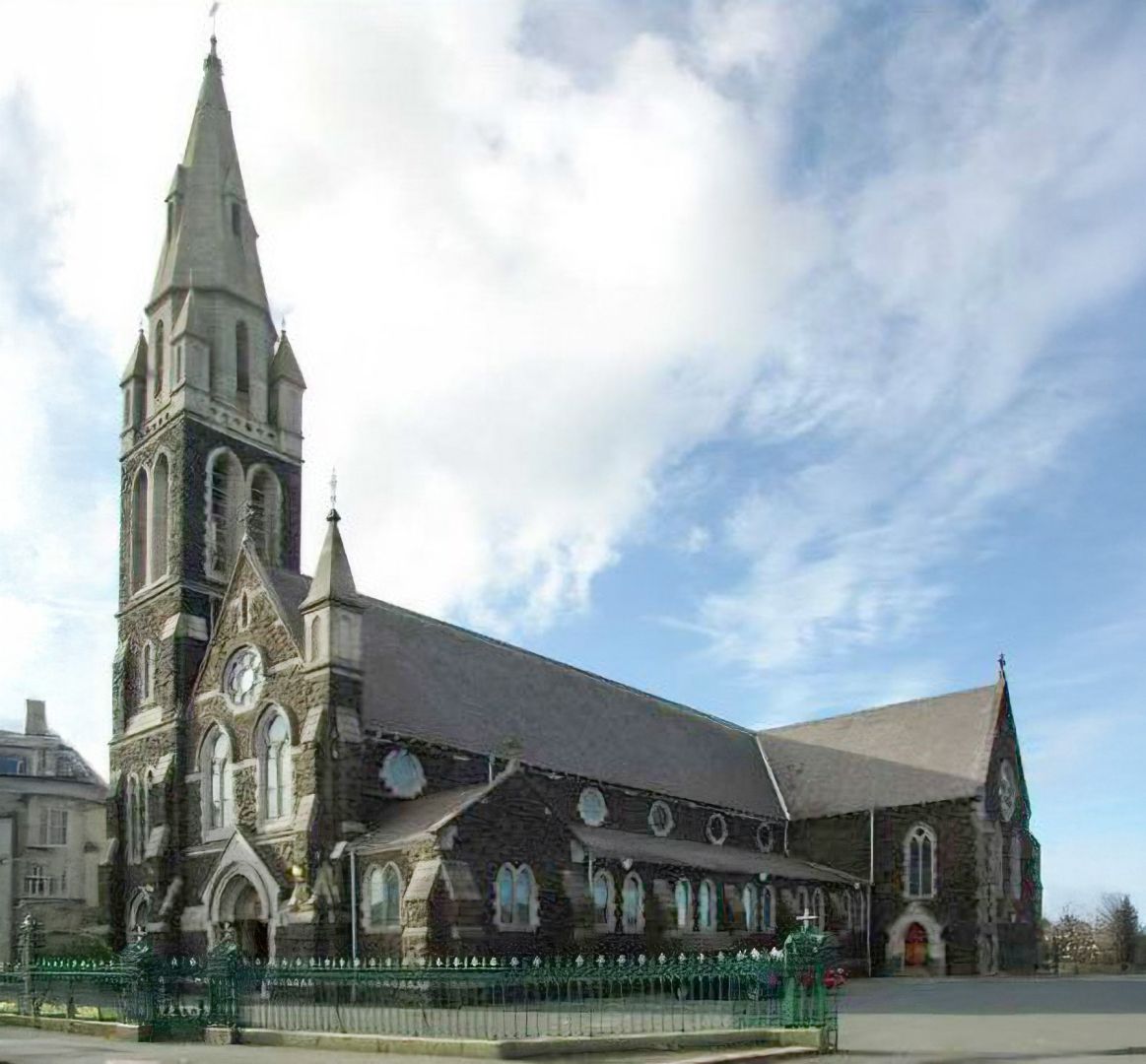
For nearly two centuries, the towering silhouette of Saint Peter’s Church has adorned the skyline of Lurgan. More than just a striking piece of architecture, Saint Peter’s is a living testament to resilience, deep faith and enduring community spirit. From its modest origins in the early 19th century to its modern transformation in the early 21st century, the story of Saint Peter’s is a fascinating journey through time.
The story begins in 1829 – a landmark year for Irish history marked by the passing of the Catholic Emancipation Act. In the wake of this historic milestone, the Very Reverend Doctor William O’Brien, Parish Priest, secured an appropriate rent-free site on North Street from Charles Brownlow (Lord Lurgan) for the erection of a new parish church.
By 1832, work on the new building was well underway. Alex Richmond’s map of Lurgan from 1832 captures a unique moment in local history, showing two Catholic churches standing close together – one in the Dougher and another in “Back Lane” (North Street). On September 1, 1833, the original Saint Peter’s Church was officially dedicated by the Most Reverend Doctor Blake, Bishop of Dromore.
Following the dedication, Doctor O’Brien converted the former Dougher chapel into the parish’s first Catholic boys’ school, establishing a tradition of local education that endures to this day. He also built a single-storey Parochial House in 1834.
As the town’s linen trade expanded and the local Catholic population grew, the Parochial House was enlarged in 1864 to support the parish’s expanding needs.
As Lurgan’s population continued to swell, so did the need for an enlarged place of worship. Between 1867 and 1869, Doctor O’Brien planned and undertook a major project to greatly enlarge Saint Peter’s with the addition of a new sanctuary, chancel, and transepts. Bishop Leahy laid the foundation stone on June 29, 1867, and dedicated the new additions exactly two years later.
A second major extension followed between 1890 and 1892, expanding the nave to bring the seating capacity to 1,200. The imposing exterior architecture was complemented by a spacious interior of refinement and ideal proportion.
The crowning glory of Saint Peter’s – its magnificent, sky-piercing spire – was conceived by Father James O’Hare, who sadly passed away in 1897 just as initial work on the spire had begun. The project was carried through and completed under the pastorate of the Reverend Michael McConville, and the spire was officially dedicated by Doctor O’Neill, Bishop of Dromore, on August 25, 1901.
Buried beneath Saint Peter’s
Beneath the sacred floorboards behind the altar in Saint Peter’s Church lies a crypt holding the remains of four priests who served Shankill Parish. Resting together beneath the sanctuary, these 19th-century clergymen guided their community from the aftermath of the Penal era, the agony of the Great Famine and the turbulent dawn of modern Ireland. To walk the aisle of Saint Peter’s is to stand directly above the remains of the men who built its walls and ministered to its people.
Very Reverend Doctor William O’Brien, Parish Priest (1796–1870)
At the heart of the vault rests the Very Reverend Doctor William O’Brien. A native of Broadwater, near Aghalee, Doctor O’Brien served Shankill Parish for nearly half a century – first as curate in 1822, then as Parish Priest from 1825 until he died in 1870.
Doctor O’Brien’s legacy was forged as much in the harrowing wards of the Lurgan Union Workhouse as in stone and mortar. During the catastrophic Christmas of 1846 – known in local memory as “The Dear Winter” – his handwritten log entries record a relentless daily ministry: baptising infants, catechising children, visiting the fever and infirmary wards, and carrying out the Funeral Rites for famine victims of all ages.
When Doctor O’Brien passed away on May 31, 1870, at age 74, his body was carried into Saint Peter’s and laid to rest in the sanctuary vault. A marble tablet, on the church wall, remains a witness to a pastor who carried Lurgan through its darkest hours.
Reverend James McKenna, Parish Priest (1829–1885)
Laid to rest alongside Doctor O’Brien in October 1885 is his successor, the Reverend James McKenna. Born in Newry in 1829 – the very year Catholic Emancipation was enacted – Father McKenna arrived in Lurgan as curate in 1863, before taking full charge as Parish Priest in 1870.
To support an expanding town, he enlarged Saint Peter’s Church, established Silverwood and Saint Peter’s schools, and embarked on an arduous fundraising and lecture tour across the United States of America.
His greatest monument to Lurgan’s youth was the establishment of Saint Vincent’s Patronage in 1882. Acquiring a grand three-storey building in Church Place, Father McKenna – with the support of the Sisters of Mercy – created a facility which offered free night school, a library and recreation rooms. Showing his extraordinary contacts further afield, he raised 3,000 pounds sterling of the founding costs directly from Catholic congregations in France.
When Father McKenna died on October 20, 1885, at the age of 56, he was entombed alongside Doctor O’Brien in the crypt beneath the sanctuary floor.
Reverend Arthur James Finnegan, Parish Priest (1823–1889)
The third shepherd resting beneath the sanctuary is the Reverend Arthur James Finnegan, whose remains were placed in the vault in July 1889.
Before he arrived in Lurgan on November 2, 1885, Father Finnegan had already established a distinguished reputation across the diocese as a theological scholar and had been President of Saint Colman’s College in Newry. He brought a deep, quiet intellect and spiritual refinement to Shankill Parish, earning the profound respect of his parishioners during a period of ongoing industrial growth.
Tragically, Father Finnegan’s ministry in Lurgan was cut short by illness. He passed away on July 1, 1889, at the age of 66 – having served as Parish Priest for less than four years. His remains were laid to rest beside Doctor O’Brien and Father McKenna in the sanctuary crypt.
Reverend Charles Betteridge (1865–1890)
The fourth priest interred in the crypt behind the main altar is the Reverend Charles Betteridge, a young curate whose promising ministry was tragically cut short just three months after his Ordination.
Born in Warrenpoint in 1865, Charles was the son of Edward and Ellen Betteridge (His father – a painter and decorator – is recorded in the Griffith’s Valuation for The Square, Warrenpoint, circa 1864). Educated at Maynooth College, he was ordained by Archbishop Walsh on June 24, 1890 – an occasion recorded in the Freeman’s Journal. He arrived in Lurgan in July 1890, to begin his ministry as curate in Shankill Parish.
Tragedy struck in September 1890. While celebrating Mass, Father Betteridge suffered a bee sting that triggered a catastrophic severe allergic reaction. His death was officially registered by the Parish Priest, Father James O’Hare – who reported it as occurring on September 13, 1890, at North Street, Lurgan, and giving – as its cause – ‘stramonium enteritis’ resulting from ‘acute anaphylactic shock’. He was just 25 years old. He was respectfully laid to rest in the vault beneath the altar, alongside his fellow pastors.
Together, these four men represent both leadership and selfless devotion. Though invisible to the congregation above, the church’s crypt remains a sacred foundation for Saint Peter’s – where these priests who served Shankill Parish rest beneath the sanctuary to which they dedicated their lives.
Later 19th Century Parochial Developments
- 1860: Halftown School (later Saint Teresa’s) was built.
- 1862: Dougher Cemetery was enlarged to accommodate the growing post-Famine population.
- 1864–1866: The Parochial House was enlarged in 1864. Edward Street schools opened in 1865 and were placed under the care of the newly arrived Sisters of Mercy in 1866.
- 1875: Saint Peter’s School for Boys opened adjacent to the church.
- 1877: Following a mission by the Passionist Fathers, a tall cross was solemnly blessed in Dougher Cemetery, marking the site of the original parish church’s altar.
- 1908: Saint Michael’s opened, initially functioning as a Boys’ Industrial School (later becoming Saint Michael’s Grammar School).
20th Century Enhancements of Saint Peter’s
- 1915: A pipe organ was installed, costing approximately 1,000 pounds sterling.
- 1922–1924: Coinciding with the Golden Jubilee of the Right Reverend Dean Michael McConville, a new marble High Altar was installed, and the sanctuary was embellished with a beautiful array of mosaics. At the same time, marble sanctuary railing was erected in memory of those Catholics of Lurgan and District who had lost their lives in the Great War of 1914–1918.
- 1925–1927: Under the direction of the Very Reverend Father O’Hagan, the sacristy was refurbished with pitch-pine compartments, a new Sacred Heart Altar was installed and the church interior was completely redecorated. Externally, the tower and spire were pointed and fine stonework was carved over the entrances – including the tympanum depicting Christ handing the keys to Saint Peter and the Papal Crest over the tower door.
- May 1927: Thanks to the extraordinary generosity of parishioners, many of whom were of deep faith and modest means, Saint Peter’s eventually became free from debt. The church was consecrated on May 19, 1927, by Bishop Edward Mulhern. The following Sunday, May 22, solemn celebrations marking the consecration took place – presided over by Cardinal O’Donnell, the Archbishop of Armagh.
- September 1933: The centenary of the original dedication of Saint Peter’s was celebrated on September 3, 1933, with a Solemn High Mass in the presence of Cardinal MacRory and Bishop Mulhern. The four officiating priests – Reverend John Patrick Burke, Reverend Arthur Joseph Sweeney, Reverend John Edward Murtagh, and Reverend David Gallery – all had cherished links with Saint Peter’s as natives of Shankill Parish.
- 1958–1959: The side altars dedicated to the Sacred Heart and Our Lady were embellished with appropriate mosaic designs.
- 1968: The entire flooring inside the church was replaced, the organ was remodelled, and the great spire and cross were repaired and fully restored.
- 1982: Following a major reconstruction of Saint Peter’s sanctuary – overseen by Monsignor Christopher Murray, Parish Priest, and architect Felix Forte – Bishop Francis Gerard Brooks consecrated a new permanent altar, facing the congregation, on December 26, 1982. As part of the reconstruction, a new ambo was fashioned from the marble of the original church pulpit. The reredos remained intact and the floor of the sanctuary was raised. The baptismal font was relocated to the front of the sanctuary.
- 1983: On October 2, 1983, a Mass of Thanksgiving marked the 150th anniversary of the church’s dedication. Bishop Brooks concelebrated the Mass with twenty-six priests, all of whom shared strong personal ties to Saint Peter’s as former parish priests, curates, or natives of the parish.
- 1994–1995: Monsignor Arthur Byrne, Parish Priest, had a new Parochial House constructed alongside Saint Peter’s Church. It was designed by Paul Monaghan and was built to the rear of the older Presbytery, which had accommodated Lurgan clergy for 160 years – since 1834.
- 2000: A further work of renovation and major upgrading was carried out on the former Saint Peter’s Boys’ School building in North Street. This building had come to serve, over previous years, as a church hall for Saint Peter’s and a focal point for parochial and local community activities.
A New Century & Restoration
In August 2009, Saint Peter’s closed its doors for essential remedial and further restorative work to bring the church up to contemporary standards. Parish Priest, Monsignor Aidan Hamill led this project, with Paul Monaghan appointed as architect. Worship was relocated to a temporary chapel at Grattan Park. When work commenced, the entire exterior was shrouded in scaffolding all the way to the pinnacle of the spire.
Taking advantage of a dry spell of weather, workers stripped, re-felted, lathed and re-slated the roof, followed by a repointing of the exterior stonework. When the scaffolding came down, the building looked noticeably cleaner and fresher.
On the town side of the site, the exterior walls of the old sacristy were rebuilt with stone which blended seamlessly with the main body of the church. The grounds were upgraded, with a newly aligned entrance gate opposite the main doors, connected by a beautiful paving layout. Additionally, a new covered walkway was built between the church and Saint Peter’s Hall to facilitate easier access and sheltered movement between the two buildings.
During this project of restoration, workmen encountered the remains of two of the four clergy detailed above – who had died while ministering at Saint Peter’s and who had been laid to rest within the church. These remains were re-interred, in due course, beneath the former High Altar. All four clergy are remembered on a memorial stone which was put in place in the newly renovated sanctuary, before the restoration work was completed.
Inside, the restoration blended Saint Peter’s rich heritage with modern craftsmanship and enhanced accessibility:
- Sanctuary & Mosaics: The sanctuary was revamped and the altar moved forward to eliminate sightline “blind spots” for the congregation. Craftsmen painstakingly restored the mosaic floor which had begun to degrade, while also uncovering – and leaving thereafter displayed – an ‘Agnus Dei’ (Lamb of God) mosaic which had remained hidden since a previous sanctuary renovation, but which was found intact.
- Historic Windows & Art: The choir gallery windows, believed to contain original leaded glass from the early 19th century, became more visible to the congregation as a result of the re-ordering of the gallery. Above the former gallery door, a beautifully restored painting of the Baptism of the Lord was treated to a vibrant cleaning and afforded special lighting.
- Accessibility & Relics: A new gallery staircase replaced where the church’s Pietà statue was formerly positioned, making the choir area easier to access. A new lift was installed to ensure full disability compliance. The Pietà was moved to an alternative location in one of the church transepts. The other church transept, meanwhile, became home to a new shrine dedicated to Saint Thérèse of Lisieux. It houses a first-class relic – a lock of the saint’s hair.
- Symbolic Features: A newly-tiled “Crossed Keys” crest – the emblem of Saint Peter – was inlaid on the church’s floor, close to the main entrance. It incorporates significant dates associated with the development of the building. The main aisle has been paved with tiles reflecting the sanctuary mosaics, leading towards a stunning ground mosaic featuring the ‘Chi Rho’, a sheaf of corn, and the Alpha (A) and Omega (Ω) symbols. New congregational seating has been installed, made from Irish ash and leaving a wider central aisle. A new cross-aisle was also created, greatly improving movement within the church.
With this major work of restoration complete, Saint Peter’s Church was officially re-opened and the sanctuary re-dedicated at a ceremony on Sunday November 6, 2011. Bishop of Dromore, Doctor John McAreavey, led this ceremony. The 2009–2011 restoration project brought Saint Peter’s Church the finest of facilities for a 21st century place of worship. While its historic stone arches, leaded glass and richly coloured mosaics honour nearly two centuries of Lurgan Catholic tradition, modern technology now allows for the transmission of Masses and other liturgies across the globe, via livestreaming. Whether for local people calling in to pray, or Lurgan natives tuning in from thousands of miles away, Saint Peter’s Church remains a truly welcoming spiritual home.
The Story of Saint Paul’s Church
Standing proudly at the historic juncture where Francis Street, Edward Street, and the Portadown Road meet – an area traditionally known as “the head of the plain”- Saint Paul’s Church has served its local community for over sixty years. The site’s transformation from being a sporting ground to becoming the location for what was once hailed the “most modern church in Ireland” is a captivating story of parish growth, architectural boldness and local pride.
Long before the foundation of Saint Paul’s, the ground on which it sits was known to locals as Celtic Park. In the early decades of the twentieth century, the ground had become the home of Lurgan Celtic Football Club. By the 1930s and 1940s the energy had shifted, as greyhound racing came to dominate the grounds.
The work of expanding local parish facilities – which eventually led to Saint Paul’s Church – began in earnest during the 1950s, under the guidance of Very Reverend Monsignor Edward Campbell, who was appointed Parish Priest of Shankill on March 20, 1955.
A major turning point for the eventual church site came in April 1959, with the passing of Miss Emile Piché (Emma) Donnelly. In a remarkable act of generosity, she bequeathed the Celtic Park site to the Shankill Catholic Parish – paving the way for a much-needed new place of worship to serve Lurgan’s gradually expanding population.
Construction & Completion, 1963–1965
- The Dublin-based architectural practice of Messieurs Thomas J. Ryan was entrusted with the design for Saint Paul’s and their proposed, bold structure challenged traditional church aesthetics.
- After groundwork began on the site, parishioners and clergy gathered for the first formal milestone of the church. Bishop Eugene O’Doherty blessed and laid the foundation stone on September 12, 1963 – a historic marker that remains visible to the left of the main entrance doors today.
- The original building contractors, Carville & Sons of Warrenpoint, encountered serious difficulties which brought site progress to a temporary standstill in late 1963.
- The immense financial pressure and structural complications took a heavy toll on Monsignor Campbell’s health. He died, before the project was completed, on January 9, 1964.
- Very Reverend James Haughey succeeded Monsignor Campbell on April 1, 1964. He immediately prioritised completing the new church.
- In April 1964, new contractors, Gilbert Ash Limited, were appointed – successfully resuming construction in May 1964.
- By the close of 1965, the ambitious plan had been realised and the new church was complete. The local press enthusiastically declared Saint Paul’s to be the “most modern church in Ireland” – boasting a seating capacity of 850 and designed to comfortably accommodate the surrounding neighbourhoods of Shankill and Taghnevan.
- Mass was celebrated in Saint Paul’s for the very first time, on the Fourth Sunday of Advent, December 19, 1965. The opening of their new church would make the approaching Christmas an unforgettable one for the local worshipping community.
- Just eight days after its opening, Saint Paul’s hosted its first wedding, on December 27, 1965. This was the celebration of the marriage of Brian Thornbury and Miss Mona McAvoy.
Solemn Dedication & Consecration, 1966
On Sunday, April 17, 1966 (Low Sunday), crowds gathered in Francis Street for the official, solemn dedication and consecration of Saint Paul’s.
- Visiting prelates were received at Saint Peter’s Church before travelling across town in a decorated car cavalcade to Saint Paul’s. The Guest of honour was the Belfast-born Cardinal William Conway (Archbishop of Armagh), who attended alongside Monsignor James Haughey and Dean Bernard Mooney (Parish Priest of the neighbouring Seagoe Parish). The liturgical procession into the new church was led by Cross Bearer, Patrick Byrne, while local members of the Order of Malta provided a Guard of Honour.
- Following the dedication ceremony, a Solemn Mass was celebrated before a capacity congregation by Canon James Burke – assisted by Deacons, Reverend Gerard McCrory and Reverend Rory McKee. All three were proud Lurgan natives. The sermon was delivered by the Most Reverend Anthony McFeely (Bishop of Raphoe). Bishop Eugene O’Doherty (Dromore) and Bishop William Philbin (Down and Connor) were also in attendance.
- Following the Solemn Mass, celebrations continued at the nearby Saint Paul’s Secondary School, where a festive reception was held.
Architectural & Design Features of Saint Paul’s
The new Saint Paul’s Church stood out as a leading example of a new style of Catholic architecture within Ireland in that era:
- Exterior and Layout: The church was built with non-traditional grey plasterwork and featured a copper roof and a small, slim tower. Two additional hexagonal rooms flanked the entrance – originally designated as a baptistry, on one side, and a mortuary on the other.
- Post-Vatican II Adaptations: Following mid-1960s liturgical reforms (Second Vatican Council reforms), the mortuary fell out of regular use, as practices around funerals gradually changed. Meanwhile, the celebration of baptisms moved from the entrance area of the church into the main sanctuary.
- Restrained Interior: The interior of Saint Paul’s was much less decorative than older Catholic church buildings. Perhaps the most striking and colourful interior feature of the church is its Stations of the Cross, set within stained-glass window panels. Neither did the church have traditional ‘side altars’ – with the emphasis being upon the main altar at the centre of the sanctuary. This altar was a gift of the Lurgan Sisters of Mercy.
- Local Craftsmanship and Gifts: The mahogany pews for the new church were carved locally, while the large wooden crucifix – fixed above the sanctuary – was presented to Saint Paul’s by the Parish Priest, Monsignor Haughey. Meanwhile, a black-and-white plaster tablet above the main entrance displays words from Saint Paul’s First Letter to the Corinthians: IMITATORES MEI ESTOTE (“Be ye imitators of me”). These words are seen as offering all who worship at Saint Paul’s a motto and an inspiration, drawn from the writings of its patron. This plaster tablet was a gift of Thomas Ryan, the church’s architect.
Six Decades of Faithful Service
While minor adaptions to the sanctuary of Saint Paul’s were undertaken in the course of subsequent decades, the church has remained largely as it was when originally dedicated in 1966. It has served the people of the southern side of Lurgan town very faithfully throughout those decades and has been the cherished setting for many familial and parochial occasions down through the years.
One particular highlight for Saint Paul’s and its congregation was the visit of the then Irish Primate, Cardinal Tomas O’Fiaich, on Easter Monday, April 16, 1990 – when the prelate celebrated a Mass within the church in the Irish language.
A series of celebrations were held in the course of 2016 to mark the Golden Jubilee of Saint Paul’s Church. Primary among these was a Golden Jubilee Mass which Bishop John McAreavey celebrated on Sunday April 17, marking – to the day – the solemn dedication of the church fifty years earlier. A commemorative calendar was produced by the parish for that fiftieth anniversary year. It relayed, through its various photographs, something of the story of Saint Paul’s.
Formal Division of Shankill Parish
The historic parish of Shankill was reconfigured in the autumn of 1992, when Bishop Francis Gerard Brooks discerned that the community surrounding and served by Saint Paul’s Church should become an independent parochial unit. This led to the creation of the new parish of Saint Paul’s Shankill. In consequence, a corresponding parish of Saint Peter’s Shankill also came into being. The decree delineating the two emerging entities was issued by the Bishop on September 4, 1992. Their territories were detailed as follows:
- Parish of Saint Peter’s Shankill: Covers the townlands of Kinnego, Clanrolla, Liscorran, Tullydagan, Tannaghmore North, Lurgantarry, Cornakinnegar, Drumnanoe, Tullyronnelly, Kilmore, and Killaghy, along with parts of Lurgan, Drumnakelly, Ballyblagh, Dougher, Knocknashane, Derry, and Turmoyra.
- Parish of Saint Paul’s Shankill: Covers the townlands of Annaloiste, Boconnell, Knockramer, Silverwood, Shankill, Taghnevan, Tannaghmore South, Toberhewney, Aughnacloy, and Tirsogue; along with parts of Lurgan, Drumnakelly, Ballyblagh, Dougher, Knocknashane, Derry, and Turmoyra; part of Ballinamoney (the remainder being in Seagoe); and part of Monbrief (the remainder being in Moyraverty).
Throughout the following two decades, each Lurgan parish had its own specific clerical personnel. However, reducing numbers of diocesan priests eventually made this pastoral arrangement unsustainable. Since late 2012, therefore, Saint Peter’s and Saint Paul’s parishes have, once again, been served by the same team of clergy.’
Doctor Francis McCorry Kieran Clendinning
Father Andrew McMahon Jim Conway